More on the sanding: plug the oil feed hole and head bolt holes with grease before sanding, and plug the pushrod holes and oil return grooves (in bewteen the pushrod holes) in the same way. Use only enough grease to cover the hole, as it will need to come back out. Any oil or grease left in the head bolt holes can cause head gasket failure. After sanding you can carefully remove the grease and any shavings it caught, get the head bolt holes clean and dry so the bolts will torque down properly
A traditional hot-tanking is not recommended by Nissan. If you do go this route, you must fit new cam bearings and have them line-honed. Since they normally last the life of the block it is a needless expense.
Better to use a shop that uses a gentler tanking method. But I wouldn't bother. After honing, the block needs hand-scrubbing anyways (detergent cleaner works best to clean the cylinders), then after assembly you can flush the cooling system to remove the surface rust in the water passages before reconnecting the radiator and starting the engine. Use a garden hose and run it until the water comes out clean. If you want you can also use a chemical flush agent from the local auto parts shop, although again I wouldn't bother unless there was baked in oil contamination
On the deck, use #400 sandpaper or equivalent scotchbrite for a nice finish. Some say to use a flat stone instead of sandpaper, but either way it ends up with some stone/sanding residue, which must be cleaned up. The goal is not to get a mirror-finish surface, but is to get it oil-free, gasket traces removed, and let the flatness of the cast iron deck stand out. Then the head gasket will last. Use light pressure and only do it enough to clean it up. Some say a mirror-finish can cause head gasket failure
Here's a properly prepped block deck
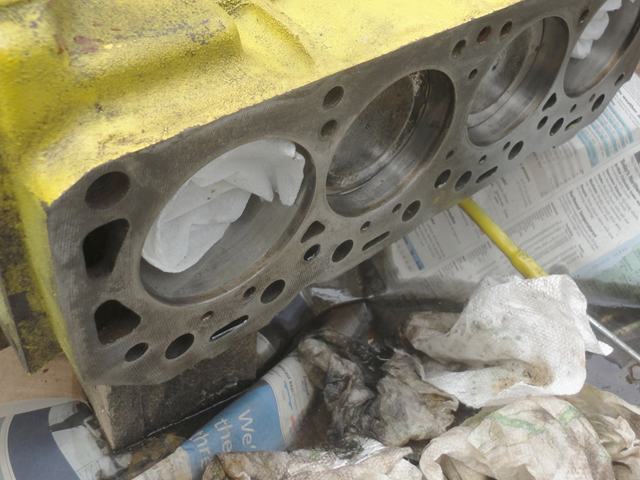
Before:


 rsz_img_3335.jpg (180.06 KB)

 Transfer


;)
;)
