The stuff below is somewhat generalised, the idea is sound, I've tried to make it 'accessible' to the average person.
DAvid Vizard did a pretty good article on this some years ago - it might turn up on car craft dot com or similar.
If we 'could' get it ideally zero backpressure is the go for power. Naturally it'a about as neighbour friendly as living next to an insomniac rock guitarist in terms of noise level however. There's absolutely no performance or economy benefits from back pressure, it's a myth at best, or maybe it's being spread by toyota fans desperately trying to get their 5k to have a chance against your A series :)
If you had access to a flowbench you can actually test the mufflers and work out the flow required (it's about 2cfm per horsepower iirc but don't quote me on that).
Another way we can measure things is simply tapping a line (run a length of copper line, coil it whatever,to cool things) and test the actual back pressure at peak hp rpms (and you can take a reasonable stab at that rpm level based on your combo, or simply measure it from 1000rpm before it, up to redline,)
Anyway - realistically you are losing power (to a significant degree) whenever it gets above about 2-3psi. Let me be clear about this, you're going to 'have' to cop some back pressure to get the noise down (in all likelihood) BUT if you can keep the back pressure down to around 1-2psi, then the relative amount of power lost is bugger all, whilst still having the noise reduced to an (arguably) reasonable level.
There's 'yet' another thing you can do to get some noise suppression with a relatively minimal amount of power loss. And this is in addition to the choice of main pipe size and muffler selection.
What I'm talking about is a pressure wave termination box. What you do is basically this. You 'want' the outgoing exhaust pulses, as they leave the main collector, to pull the next cylinder's exhaust out (or help it at least). So we 'still' want those pulses at the collector. But beyond that we don't need them and (relatively speaking they will be responsible for a lot of the noise signature) we can even get slightly more efficient flow trhough the muffler by terminating these pulses or more accurately smoothing them out into more linear flow.
The trick is simple enough - you run your normal final (or main) collector - around 2 inches in diameter, possibly 2 1/4 for an absolutely hard core ultra rpm a15 or larger motor, but likely 2 inch for anything short of that, then after this collecter, you have a _significant_ and 'instant' increase in the cross section area of the exhaust, then you 'taper' (or funnel shape) it back to the main exhaust size (2 inches, maybe 2 1/4) and back toward the rear muffler.
In 'theory' the hot-dog or resonators put in the exhaust before the main muffler do this to some extent, but they aren't nearly as effective as a properly designed one.
The only 'problem' is finding enough underbody space to fit this pressure wave termination box. Generally the larger the better, but if you could get it to around 3-4 litres internal capacity, that'd be enough to do the trick, 4-6 would likely be better but unlikely to be easy to fit.
Apart from the above described theory, you could basically think of it a bit like this, it almost 'fools' the exhaust gases into thinking it actually has a collector that vents to the atmosphere, rather than it then going through a muffler.
You can play with final collector length (I've already mentioned where you'd be aiming for as far as diameter goes) Somewhere around the 8-12 inch mark is probably where you'll get the most benefit.
For most streeters, you'll actually find a bit of mid range (and no loss of peak) power with longer primary pipes that most off the shelf headers for the a series powered datsuns. I suspect that for the most part their length is what it is due to the issue of clearance as it passes the gearbox bellhousing region. It's not enough of a difference that it makes any off the shelf headers 'rubbish' just icing on the cake stuff (primary pipe diameter is by far the most crucial issue).
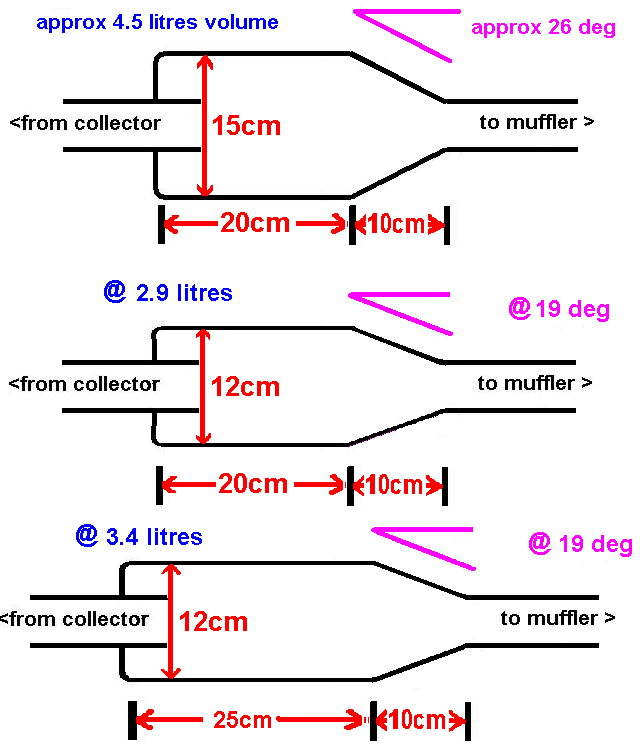
I've done a couple of diagrams with approximate volume. The one at the top is better volume, but could probably benefit from a slightly more gentle taper at the rear (I couldn't be bothered doing the math and putting a 4th example there, but just a bit less of an angle)
The middle one is what might more easily fit without having to bash the floorpan up wards for clearance, but suffers a little from less volume, so might have to be a bit longer.
That's the basic shape, and easy to fabricate If you wanted to you could also radius the 'tail' end near where it meets the exit pipe. You could also look at making an 'oval' shaped one - it would work better if it is round, but if you can't fit it then an oval shaped one is better than none at all to be sure...




 Transfer







;)
