No life (a.k.a. DattoMaster)  
Joined:
2008/10/10 22:02
From Melbourne Australia (and likely under the car)
Group:
Registered Users
|
Let me be clearer here David - even if you aren't looking for hp records, I'm trying to tell you you need to do a #OOPS#load to an a series head to support that sort of capacity. Contrast that with, for example, the sr20ve head. Decent porters have gotten them to flow enough to support close to 300bhp (to be honest I don't have the current state of this, that's a few years ago now!) without the sort of 'commando' porting that might be necessary on others. Those heads will support massive flow and supply a 2 litre engine very well, and over a broad rpm range.
With respect to the head you are talking about for the future, if you are getting major welding done, if they don't take out all the guides and seats and studs first, you may as well not bother. With significant welding like this, EVERYTHING moves around, and having anything 'stuck' in there will affect it. You'll need to weld it, heat treat it (maybe) and straighten if necessary, then re-machine practically everything. If they are asking less than around 3-4 grand for the whole job, I can't see how the hell they are going to do it. And keep in mind, if you wanted torque, a supercharged a14 (or 15) will poo on it from a great height, for about 1/5th the overall cost.
Another thing I'd bring up, which I was going to with the previous post, but honestly just forgot. And ironically you have mentioned it again. You seem (and I mean this a bit tongue in cheek, don't take this one to heart) a bit obsessed with rod: stroke ratio. GRanted, if it is really 'bad' in an engine - perhaps 1.4ish or less, then the side thrust and friction is a bad thing. BUT there's a situation called the case of diminishing returns, where if some does X% improvement, then double that feature might only do 1.25 as much improvement, instead of twice the improvement, and you can eventually get to the point where it COSTS power.
You see the issue is two fold. The longer the rod, the longer (in crank degrees) the piston will dwell around TDC. This slower 'turnaround' can help save breaking a piston or a rod at high rpm. BUT if the engine doesn't have a problem throwing rods or otherwise letting go at big rpms, then this is not a good thing. But the other thing is that the quicker the piston moves away from TDC, at more modest rpm ranges (the precise range you are aiming for with the desire for big torque figures) then the quicker and stronger the pressure drop and signal or 'pull' on the intake port. ANd basically at lower rpms it gets teh intake flowing quicker, which leads to more mid range torque. In engines built to make power at more modest rpms (and if you look at the enginemasters challenges that were done a few years ago, maybe still going, they change the capacity etc each year to try and get new combos entered but the general 'winner' is the motor with the most average power from 2500-6500rpm, rather than any peak power figure. Now whilst you might find 1.75:1 or longer rod ratios for higher revving circuit racers, engines built for this situation often had ratios 1.6:1 or lower, and performed better for it).
If that wasn't a good enough reason, antother point is relatively long stroke engines (and even the stock stroke a15 qualifies for this imo) tend to want slightly closer lobe separation angles. This closes the exhaust valve a little later, and opens the intake valve a little sooner. Now the problem here is that if the piston is hanging around a lot longer at TDC, you can't close the exhaust valve as late, as it will still be hanging open and the piston will hit it on the upstroke, and the piston will still be there, so you can't open the intake valve as early as ideal, or it will hit the piston too. Now you are stuck with a wider lobe separation (potentially speaking) for any given duration and it will work less effectively for a big a-series in general, and if anything, it will kill off some mid range torque, and give a small gain (but not as much as it loses down in the mid range) up top. Which is close to the exact opposite of the stated goal.
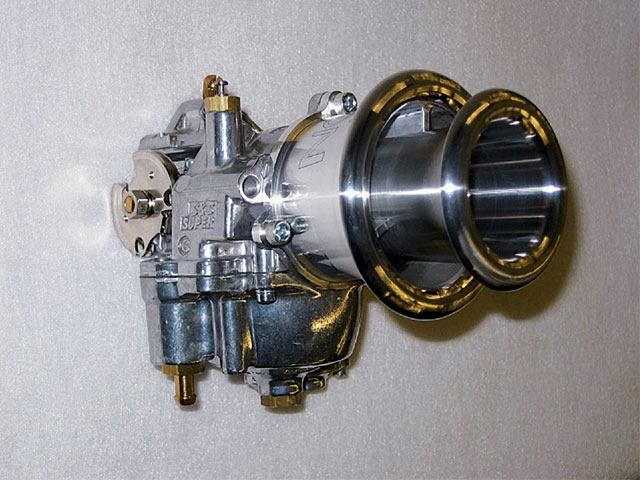
Another issue I'd mention is carb size. In the past you've often (that I can recall, I don't stalk you so I don't read every post!) suggested a 1 3/4" SU as being adequate for a drawthrough, but here you are considering a >2" SU for an NA engine. Here's teh thing, yes the turbo can force feed air/fuel into the engine well above it's ability to draw it in normally aspirated. BUT in a drawthrough, even though the turbo compressor wheel can create a massive pressure drop behind the carby, it is still up to atmospheric pressure to push the air in through the carb. So in a drawthrough, much like an NA engine, you'll actually find that the size of carb that can supply X bhp for an NA engine of some type is about the size you want to attain X bhp for a drawthrough turbo. SO if an NA 1800cc engine will 'like' a big SU, it should become fairly obvious that even a modest boost drawthrough a15 will too. Since that turbo can produce a larger and constant pressure drop behind the carb, it WILL still make good power with a 1 3/4 SU, so for a streeter it's not a huge concern really, but for something more serious it's fairly easy to make a good case for either a 2inch SU or perhaps twin 1 3/4" SUs for a drawthrough. Knowing from experience (and I bashed my head against brick walls for a long time with this sort of stuff back in the late 80s and early 90s when it was impossible to get any exhaust shop to put a 3 inch exhaust on a turbo 6 for example) anyhoo, it became clear that for around 200bhp twin 1 3/4" SUs on a drawthrough wasn't a bad option. You'd 'get' it with a single, but there'd be so much more back pressure as the turbo has to work that much harder to manage to get sufficient air in through that carb to produce the same boost levels (and create more heat in the process, putting one closer to detonation)
Seriously there's almost nothing in engine building where 'if some is good, more is better'. It's almost always a case of 'what's the best set of compromises that gives the best overall result' Certainly there is out of the box thinking, but there's still this catch called 'the laws of physics' Certainly, it's still down to massive trial and error but there's going to be general trends in what works and what doesn't and the underlying reasons why.
If you are wondering where I'm going with all this - here it is: If you want big torque, and decent hp (you may not want 'record' hp levels, but you will definitely be able to outpower ANY NA a-series, on pump fuel, and that's just a fact) - well the truth is NOTHING works like forced induction. You can pick up a supercharger or turbo for pocket money, a big enough SU, an oval port head, a mild cam and std (albeit freshened up) bottom end, and maybe water injection. You'll snot any NA a series, and do it with rpm levels that will mean it will last as long as a stock a15 will.
I strongly urge you to consider it David, it'll cost you way less, last way longer, and if it eventually did wear out or break, you aren't 'destroying' a head worth more than 90% of the complete cars on the road of this type.
Posted on: 2013/11/15 10:24
|




 A serious head kamikaze.jpg (51.78 KB)

 Transfer